• Fractiv, Offsetting

    Anybody still fondly recall Project Offset, the FPS/RPG Intel bought for internal development? Unfortunately, this grand and ambitious project got canned by Intel quite some time back. The good news, though? Surprisingly, old members of the Offset Studio have already set up new shop in Santa Clara, California under the moniker Fractiv and have even released their first game, Lane Splitter, for the iPhone and iPad (with Android to follow shortly). As cheesy as its premise is, the game actually looks pretty funny!The bad news, then? Intel does own everything the team produced before and during their stint for the behemoth. Project Offset, their magnum opus, will never see the light of day sans a slew of really cool videos and demo reels. Sniff. Talking to Bigdownload, though, studio leader Sam McGrath didn’t seem all that heartbroken, even if the long development process ultimately resulted in the cancellation of the project.

    In the interview, McGrath recounts the early days of the project, telling that before they went to work at Intel, the team

    …developed a graphically impressive, fully playable prototype, as well as developing core engine tech at the same time. Due to circumstances out of our control, the publisher we were working with decided to shift their company strategy in a direction that did not involve PC games, and our project was cancelled. Luckily, we had a very good contract with them that allowed us to retain the rights to our IP.

    Wow, talk about a close shave there.

    (more…)

    Continue reading →: Fractiv, Offsetting
  • No Deal for Dead Island

    That Dead Island trailer – supposedly created by the Glasgow-based animation studio Axis Animation – has already been viewed far over 3 million times on Youtube, with an equal amount of tweets to go. Its popularity has, in turn, turned up quite a fair bit of misinformation that now surrounds the project. As things stand, a clarification to our earlier report is in order: Unlike previously reported, no movie deal for the game has yet to be made.

    In speaking to LA Times’ 24 Frames, Koch Media representative Malte Wagener stated that

    There are a lot of different stories out there but the bottom line is that neither Union nor Sean Daniel has ever talked to Koch Media. Richard [Leibowitz, of Union] and [game developer] Techland agree there was never any rights.

    I personally find it more than a little troubling that so many respectable film websites would report the deal as fact, which in turn leads me to question Koch Media and Deep Silver’s role in the propagation of the news. While I don’t think this sort of misinformation bodes well for the negotiations of a potential adaptation of the game, it’s frankly quite futile to discuss any of this as both the film and the game are still but a ghost in the hype machine. At the time of writing, Dead Island is coming out late 2011.

    Continue reading →: No Deal for Dead Island
  • , ,

    Gemini Rue (P)review

    Gemini Rue, an IGF 2010 Student Showcase winner under its previous title, Boryokudan Rue, is Joshua Nuernberger’s first full-length commercial title that successfully follows up on the promising path already travelled by the developer’s first adventure game title, La Croix Pan. Dave Gilbert’s Wadjet Eye Games is to publish the game today, 24th of February, and a demo was made exclusively available at GameFront yesterday.

    The game, a film noir/sci-fi adventure, is of two separate halves: Players control Azriel Odin, with the help of his partner Kane Harris, sneaking into the colony of Barracus in search of an informant known as Matthieus Howard. Interwoven between Azriel’s sections also figures the mysterious prisoner-patient Delta-Six, an amnesiac confined to and conditioned in a sterile facility with totalitarian, Pavlovian means.

    An equal split between the two halves exists not only narratively, but also visually: On the surface of Barracus (a “New Pittsburgh,” as it is described), where habitable conditions are sustained by weather towers, where the constant presence of rainfall plagues the colony, its hammering rattle contrasting strongly with the sterile silence and cleanliness of the facility Delta-Six remains confined in. Where Delta-Six is a silent, worn-down man deprived of his humanity and personality, Azriel is a keen-eyed man of action and freedom, constantly entangled in danger, shootouts and the narrowest of escapes.

    (more…)

    Continue reading →: Gemini Rue (P)review
  • No Man Is a Dead Island

    …but maybe a zombie is! A singular and unique, expertly designed trailer was all it took to light a fire under the video gaming community, bringing a slow and deliberate simmer to an absolute, absolute boil. This trailer, with its decidedly nihilistic take on the zombie mode, exhibited in reverse and to a haunting piano-based soundtrack, has been called the best trailer of the year (in February!) on several sites already, for instance, by LA Times’ 24 Frames, The Escapist, Unreality, and Ain’t It Cool News:

    This heavy praise heaped on the sudden smash hit of a trailer, of course, was directed towards Techland’s Dead Island, now officially housed under the wings of the German publisher Deep Silver. The game has indeed been simmering under the surface for years, with first indications of the game’s free-form, melee-based survivalist direction coming in late 2007. And then silence.

    (more…)

    Continue reading →: No Man Is a Dead Island
  • XCOM Gameplay Trailer is Intense

    There’s not much new to report on XCOM, the “re-imagining” of the PC classic which we’ve covered here before. But last year at E3, 2K Games finally released a brief trailer showing in-game footage for us to pick apart, and I thought I’d bring us up to speed. Click through to see the video embedded below.


    (more…)

    Continue reading →: XCOM Gameplay Trailer is Intense
  • , ,

    ReVVVVVView

    Terry Cavanagh‘s seminal platformer VVVVVV dropped last January, and I gave a brief heads-up noting its brutal difficulty and audacious $15 pricetag. Since then the game has hopped onto the Steam bandwagon and has had its price slashed to a much more reasonable two-thirds less , which makes it an irresistible indie option for platformer fans. And as I mentioned in my recent summary of 2010, VVVVVV turned out to be one of my favourites of the year.

    You play as space Captain Viridian whose crew is scattered across a space station in a strange alternate dimension. The controls are extremely simple, you can move left and right, and switch the direction of gravity. There is no jump or changing direction in between a la And Yet It Moves – you can only either fall downwards or upwards. The mechanics don’t change or become more complex than this; within this basic framework Cavanagh pits you against the environment and enemies in ways that will test your reflexes and your muscle memory. The game is compatible with a controller, but the keyboard is absolutely sufficient. The acceleration curves may take a little getting used to; while the controls are responsive, your affable avatar carries momentum which may leave some players grumbling about his delayed stop.

    The initial few minutes of the game have you negotiating a series of rooms with traps and creatures, but the game soon opens up and you are given much more freedom in your exploration and the order in which you rescue each crew member. In addition to the main objective, there are various trinkets placed around the world, requiring you to do the near-impossible to reach them. Believe you me, some of them are a downright bastard to get. Getting them all unlocks a postgame feature, but I suspect the self-satisfaction and bragging rights will be reward enough for your persistence. Every now and then you may encounter a computer terminal that will impart snippets of story or reveal a new area on the map. Talking to your crew once you have rescued them also expands on the story, which is surprising.

    (more…)

    Continue reading →: ReVVVVVView
  • Interview with Epic Games’ Jay Wilbur

    Since its inception in 2008, the Dubai World Game Expo has been the annual showcase for game developers in the Middle East. In the last few years many western studios have taken an interest and have come to sponsor or give panels, including CryTech, Blizzard Entertainment, Electronic Arts, and Epic Games.

    Epic had a large presence at DWGE 2010, showcasing their latest development tool, the Unreal Development Kit. Their booth featured a workshop with tutorials on the basics of the UDK, and representing Epic at DWGE were Jay Wilbur, Vice President, as well as Markus Arvidsson and James Tan – two of the independent developers behind UDK-based game The Ball. I sat down with these fine gentlemen to discuss a variety of topics including Unreal Engine 3, the UDK, and games development in general. What follows is my conversation with Jay.

    The Slowdown: The Unreal Engine has a long history of licensing and modding; how did the decision to launch the Unreal Development Kit only come about now after all these years?

    Jay Wilbur: So, all the while, we’ve always made our games open and available for people to mod – Unreal Tournament 3, going back to the original Unreal. People would be able to use the tools to make their own mod. But that locks those creative endeavours to the game, so somebody else would need to own that particular game in order to play the mod. With the UDK, we’ve freed developers to create standalone applications, turn it into a standalone playable entity – asset, I should say, and then deliver it to anybody who wanted to play it. They wouldn’t necessarily need to own that game in order to play it. So the goal was basically to have more people use Unreal Engine 3 in the development and also have more people be able to play the end result.

    (more…)

    Continue reading →: Interview with Epic Games’ Jay Wilbur
  • ,

    2010: The Year in Review

    I’ve not been as active on the Slowdown as I’ve liked lately, something I hope to rectify this year. As it happens, I was actually playing games! Which left me with less time to write about them. 2010 was a very busy gaming year for me; the sheer number of quality titles was staggering, and I’ll try and give a brief mention to some of my personal favourites.

    While I did enjoy a handful of the huge AAA releases in 2010, I would have to say that I’ve gotten stuck in deep into the indie scene, playing countless magnificent small scale titles be they fleetingly minimal or elaborately ambitious. RPS brought charming indie effort Recettear: An Item Shop’s Tale to my attention, for which I’m ever so grateful. A cute little JRPG that turns the institution on its head and offers a twist on the tired formula of grinding and item management, Recettear had me spellbound for the duration of its campaign – after which there is still much more to discover. I will most definitely return to it to tackle its postgame modes. I spent a lot of time platforming too, mostly with VVVVVV and Super Meat Boy, two triumphant celebrations of the genre. Both incredibly challenging, but hopelessly addicting.

    Despite being hopelessly terrible at strategy games, I continue to be fascinated by the many indie strategy offerings out there. Flotilla, from Blendo Games – the same nutters behind oddball Gravity Bone – is a quirky turn-based strategy adventure, reminiscent of previous procedural exploration series Infinite Space. I dig the flat-shaded glowing graphics, the simplicity of its mechanics and the bite-sized gameplay, all of which make for a great quick-fix. I am very much looking forward to the asynchronous turn-based Frozen Synapse, due out very soon. I fired up the beta client often the past few months, and enjoyed the Introversion-like aesthetics and intricately detailed command controls. The second Humble Indie Bundle contained a gem of a tower defense game, Revenge of the Titans, which overcame my dislike for the subgenre and wooed me with its distinct look and tight design.

    Having joined the smartphone bandwagon this year, I have been trying to find good games for it, but the selection is disappointingly small save for a few fun time-wasters. Angry Birds has been quite the success story, and I can’t deny that I’ve spent many an idle moment trying to topple some towers. Game Dev Studio, the popular iPhone game about making games, finally came to Android so I was able to get a taste of its completely addictive grind.

    I had a good time with all of these titles, but what blew me away in 2010 were the three games I was anticipating the most.

    (more…)

    Continue reading →: 2010: The Year in Review
  • ,

    Steam Treasure Chest

    Over the past two weeks, we were able to highlight three fantastic budget-sized and -priced titles available in the massive Steam holiday sale. With one final day left of the sale, there’s still hopefully just enough time to recap these reviews and perhaps help you make that final decision to grab – or pass – a title or two! Below, you’ll find one-paragraph snippets from and links to our reviews:

    Shatter

    “Originally released on the PSN, Shatter is on the surface a high-definition rendition of the Breakout genre, perhaps resembling most closely the classic Arkanoid. Shatter’s claim to the throne, then, is its frustration-free flavour; where other games of the genre may have traditionally strained players with punishing difficulty, Sidhe have altogether subverted the problem by introducing a mischievous sucking/blowing mechanism for your bat, used not only for gathering shattered energy fragments that dissipate from broken bricks, but also allowing players to gently guide their ball’s trajectory curve both left and right.”

    £3.49, $4.99, 3.99€ – read more on Shatter

    The Misadventures of P.B. Winterbottom

    “Published under the 2K Play budget moniker and developed by the aptly named the Odd Gentlemen, The Misadventures of P.B. Winterbottom is a story of the titular gentleman thief getting suckered into a paradox of time, place and the self. His strange-sounding shenanigans are dressed in lavish Victorian-style steampunk and early filmic elements, coated with a glaze of Edward Gorey – rated “E” for “Comic Mischief” by the ESRB – and finally capped by the swinging sounds of a boisterous backing band – sporting harpsichord, bassoon and all – not too unlike Tim Burton’s go-to Oingo Boingo man Danny Elfman’s gothic scores. All this in Adobe Flash!”

    £0.39, $0.49, 0.39€ – read more on The Misadventures of P.B. Winterbottom

    Dark Void Zero

    “The second aspect that makes Dark Void Zero stand out from the pack is its aforementioned fictional wrapping. Rather than simply giving the game a retro-style audiovisual coating, Other Ocean have gone so far as to implement in the game the aspects that define the games of the past, including their worst. Expecting the game to play like recent game, or say a forgiving rendition of the Mega Man topos, is a surefire path to disappointment. Instead, Dark Void Zero has been designed to leave a lingering taste of haemoglobin in your mouth – and in fact, biting through this all too-familiar a flavour of iron is one’s best weapon in soldiering through the annoyances of the game.”

    £2.00, $3.34, 2.67€ – read more on Dark Void Zero

    Giveaway

    To roll with the theme, we have a budget-sized giveaway reserved for this occasion – you are eligible to win a digital download of the fantastic Shatter OST by the artist Module if you

    1. Retweet this tweet
    2. Follow @slowdownvg on Twitter.

    Both requirements need be fulfilled when the contest ends Thursday, the 6th of January, 16:00 GMT. We will randomly pick a winner and direct message you the details.

    Continue reading →: Steam Treasure Chest
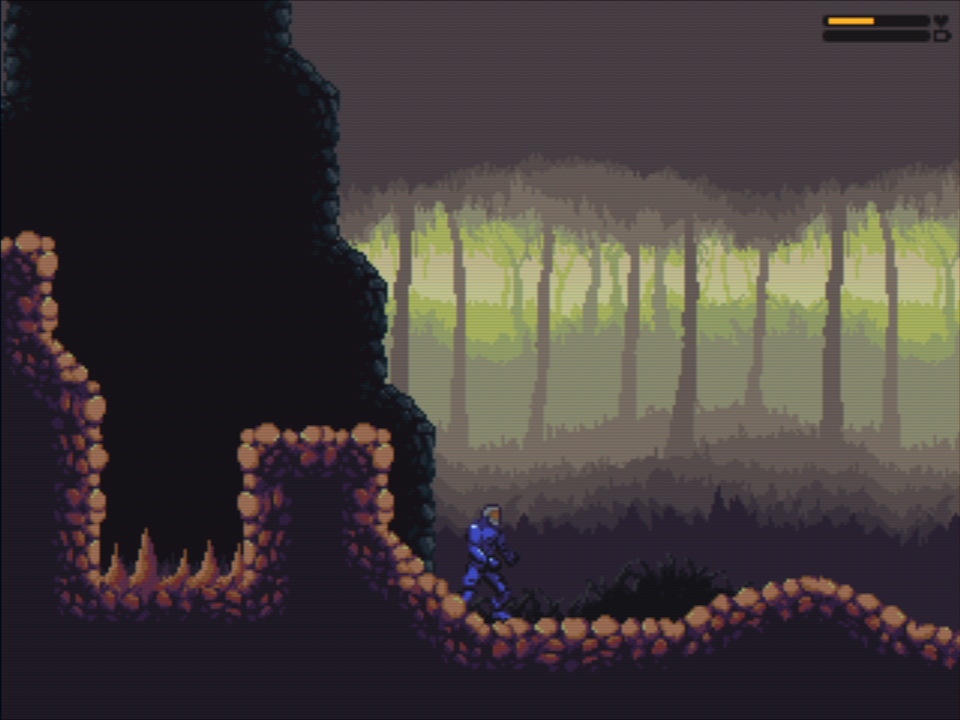
  • No beating about the bush: First and foremost, Other Ocean’s downloadable minigame Dark Void Zero brings your inner AVGN to the fore, the game being above all a meticulous, studious replication (compared to a revision or a reimagination) of the features that often make older games so highly resistant to enjoyment, in turn rendering the game an easy target for naggish nitpicking.

    Before its release, the PC and DSiWare title created a minor stir in the games press with its cleverly orchestrated marketing campaign, one that laid out for the game lavish faux origins, as Capcom claimed the game had started off as an ’80s Mega Man clone “locked away for decades.” All this served, of course, to drum up more publicity for its mothership, the triple-A Dark Void, which unfortunately flopped creatively and commercially, perhaps undeservedly banishing Dark Void Zero to the kind of, uh, dark void of infamy that its fictional trappings prophesied for it in the first place.

    Indeed, Mega Man is the most evident point of comparison together with the first Metroid, though Dark Void Zero does replace Samus’ ball form for a jetpack, and allows players to shoot into eight(!) directions. Make no mistake, though, these features do not exist simply to make your life easier. In the game, you play as Rusty, a test-pilot sent into the Void, a galactic no man’s land between Earth and the homeworld of an alien threat known as the Watchers. These beings are ominously making their way to Earth by means of a series of portals, and it’s up to the player, with the aid of the great scientist Nikola Tesla, to gain control of these portals and put an end to the menace.

    Dark Void Zero goes above and beyond in staying true to its eighties influences. This is evident chiefly in two major ways, the first being its level of difficulty, which comes in beautiful blacks, reds and blues – the hues of an ass-whooping, of course. With this I refer the very deliberate slipping of the player into molten rock articulated in a highly inaccurate, block-based projectile collision detection and exacerbated by a complex two-mode jetpack. The game also extends its sadistic tendencies to text boxes (see on the right) and alerts, which cover from a quarter to an entire third of screen estate, forcing you to slowly skip through information and wait for alerts to pass – or face the potential consequences of slipping into a pool of lava hidden under the box.

    As you make headway, fighting through the controls, the collision detection, the alert boxes and the overall difficulty, you’ll eventually come face to face with the very first boss. More than likely, you’ll be on your very last legs, only narrowly edging out the Watcher beast and discovering in the subsequent level that Other Ocean have blessed you with a continue! But make no mistake, this is no ordinary continue, this is your grandfather’s continue had video games existed in the roaring twenties: Instead of awarding you a full set of lives, the game is content with handing out the exact amount of lives in your possession at the time of saving. In other words, to actually benefit from the continue, which is thus more of a save feature, you need to be able to hold on to your lives – otherwise, it’s simply easier to restart and replay the entire game… the tip, the point of this highly barbaric design, of course!

    (more…)

    Continue reading →: Steam Treasures: Dark Void Zero

Welcome to the Old Internet…

We’re slowdownvg, a blog for those who spend more time thinking about gaming than gaming.

Themes

Pages

Favourites

Let’s connect

The Slowdown